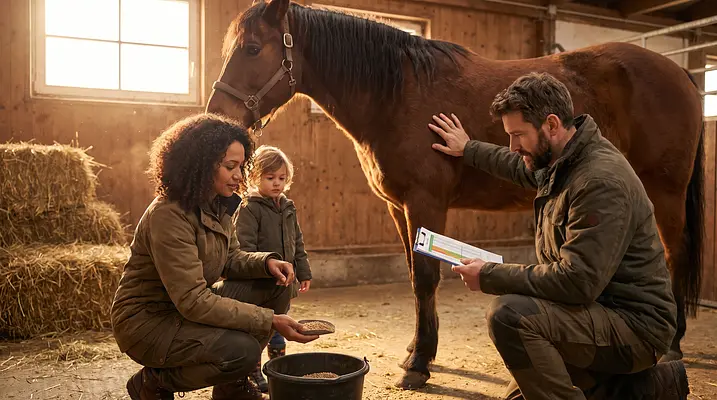
Run your hand along your horse’s neck, slide your fingers under the belly, and feel for the ribs just behind the shoulder. There is a specific smoothness to a healthy topline that tells you more than any textbook definition ever could, revealing the story of their nutrition right beneath your fingertips. When the ribcage is hidden under a spongy layer of fat or protrudes sharply against the skin, the diet needs immediate adjusting to ensure long-term soundness and vitality.
🌿 The Foundation: Forage First
Horses are designed to graze continuously, making forage the absolute cornerstone of their digestive health and overall happiness. Providing a constant supply of appropriate forage prevents ulcers, reduces stress, and mimics their natural grazing instincts.
- Provide access to clean, quality grass hay for the majority of the day.
- Offer hay in a slow-feeder net to extend eating time and mimic natural grazing.
- Test your hay annually to understand its nutritional profile and sugar content.
- Supplement with a high-quality ration balancer if your hay lacks essential vitamins.
- Ensure fresh water is available at all times to aid in digestion and hydration.
🌾 When Grain Becomes Necessary
While forage should make up the bulk of the diet, certain horses require additional calories to maintain their weight and energy levels. Grain becomes necessary when workloads increase significantly or when a horse struggles to keep weight on despite ample forage.
- Introduce grain only when the horse cannot maintain weight on forage alone.
- Choose a feed with a high fat content, like rice bran, for safe weight gain.
- Split grain into multiple small meals to prevent starch overload and digestive upset.
- Measure feed by weight using a scale rather than volume to ensure accuracy.
- Select a feed specifically formulated for your horse's life stage and activity level.
📊 Understanding Body Condition Scoring
Body condition scoring is a hands-on tool that allows you to objectively assess fat coverage over specific areas of the horse's body. Using the Henneke scale of 1 to 9 helps you make informed decisions about dietary adjustments before problems arise.
- Feel the ribs to determine if they are easily felt but not visually prominent.
- Check the crest of the neck for firmness or spongy fat deposits.
- Examine the tailhead area for fat accumulation or a visible outline.
- Look for a smooth, level topline along the loin and back.
- Assign a score between 1 (emaciated) and 9 (obese) with a goal of 5 to 6.
📝 Adjusting the Diet Based on Scores
Once you have established a baseline body condition score, you can fine-tune the diet to help your horse reach or maintain an ideal weight. Regular monitoring allows you to make small, proactive changes rather than drastic corrections later.
- Increase forage quality and quantity slightly if the score is below 5.
- Add a calorie-dense supplement like beet pulp for hard keepers needing extra energy.
- Reduce calorie-dense concentrates immediately if the score creeps above 6.
- Soak hay for easy keepers to reduce sugar and calorie intake.
- Re-evaluate the body condition score every two weeks to track progress.
Caring for a horse is a journey of observation and small adjustments, where the simple act of running your hands over their coat becomes a daily check-in on their well-being. By prioritizing forage and using body condition scoring as your guide, you ensure that your equine partner remains healthy, comfortable, and ready for the trail ahead.
🚀 Quick Action Plan
- Feel your horse's ribs and topline today to establish a baseline score.
- Evaluate your current hay supply and check for dust or mold.
- Weigh your horse's grain ration using a kitchen scale.
- Schedule a consultation with an equine nutritionist if you are unsure about ratios.
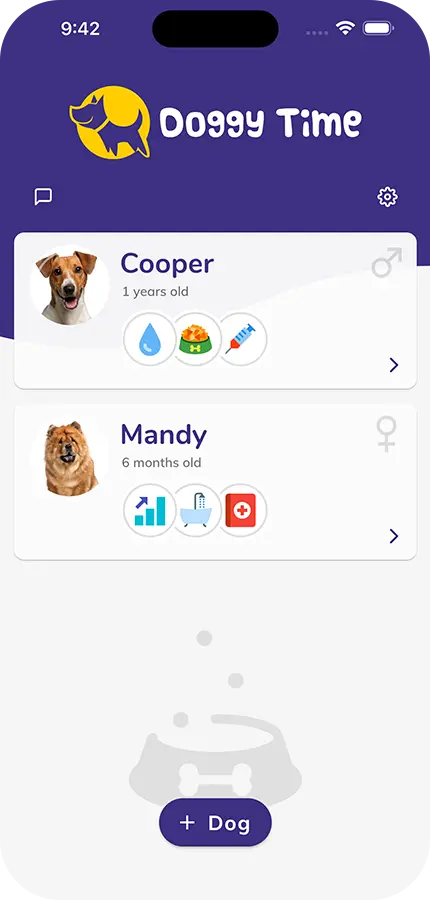
- Download the Doggy Time app to log feeding times and body condition notes.
Disclaimer: This blog post is for informational purposes only and does not constitute veterinary advice. Always consult with a qualified equine veterinarian or nutritionist before making significant changes to your horse's diet.
Keeping track of feeding schedules, supplement routines, and body condition notes can be a challenge, especially in a busy barn. The Doggy Time app helps users collaborate on logging pet activities, training, and other items, along with smart alarms and scheduling to ensure nothing falls through the cracks. Our pet tracker & training log helps you track your pet's daily habits and health, working for dogs, cats, rabbits, birds, reptiles, and 30+ other pet species.