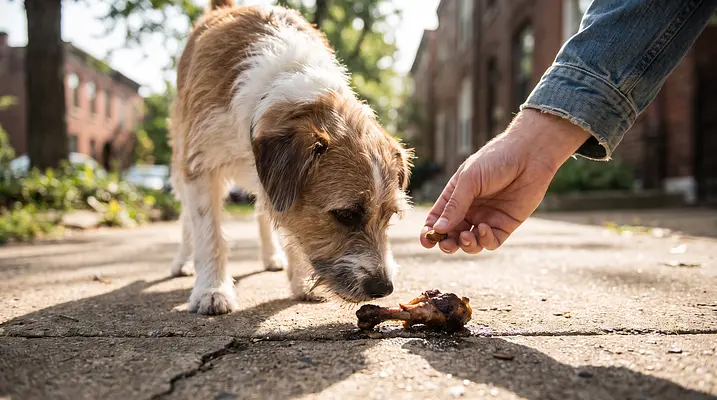
It’s a sunny afternoon walk, the kind where the leash is loose and the tail is wagging, until you spot it: a greasy chicken bone lying right in the middle of the sidewalk. In a split second, your relaxing stroll turns into a high-stakes race against your dog’s instincts. You see the bone, your dog smells the bone, and his mouth is already opening to gulp it down before you can even react.
Scenes like this are exactly why every dog owner needs two specific safety cues in their back pocket: "Leave It" and "Drop It." While they might seem similar, these cues serve two very different purposes, and knowing both can save your dog from choking, poisoning, or a very expensive visit to the emergency vet.
🧠 Understanding the Difference
Many pet parents use these terms interchangeably, but to a dog, they are worlds apart. Teaching your dog to distinguish between the two ensures they know exactly what you are asking in a moment of crisis.
- Define "Leave It" as a command to ignore something the dog has not yet touched.
- Define "Drop It" as a command to release something already in the dog’s mouth.
- Think of "Leave It" as prevention and "Drop It" as intervention.
- Use "Leave It" for stray food on the sidewalk or a squirrel darting up a tree.
- Use "Drop It" for that stolen sock or the inappropriate chew toy they’ve already claimed.
🚫 Training "Leave It"
This cue is all about impulse control and teaching your dog that patience pays off. The goal is to teach your dog that looking away from a temptation is more rewarding than grabbing it.
- Start with a low-value treat in your closed fist and hold it out to your dog.
- Wait for your dog to stop pawing or sniffing your fist and mark the behavior with a "Yes!" or clicker.
- Reward your dog with a different treat from your other hand, never the one in your fist.
- Repeat this process until your dog automatically pulls away from your fist when presented.
- Progress to placing the treat on the floor while covering it with your hand or foot.
- Uncover the treat briefly and cover it again if your dog lunges for it.
- Add the verbal cue "Leave It" just before you present the temptation.
- Increase the difficulty slowly by using higher-value treats and longer wait times.
🎾 Training "Drop It"
This cue is essential for retrieving dangerous items without initiating a game of chase. It relies on teaching your dog that giving something up doesn't mean losing out; it means trading up.
- Begin by playing with a toy your dog likes but doesn't obsess over.
- Offer a high-value treat or a second toy while the dog is holding the first item.
- Say "Drop It" the moment your dog releases the object to take the treat.
- Give the treat immediately and praise them enthusiastically.
- Return the original toy to them occasionally so they learn that dropping doesn't always mean the fun ends.
- Practice this exchange frequently during play sessions to build a positive association.
- Gradually increase the value of the item you ask them to drop, moving from toys to bones or chews.
- Avoid chasing your dog if they grab something, as this turns "Drop It" into a game of keep-away.
⚠️ Common Pitfalls to Avoid
Training doesn't always go perfectly, and it is easy to accidentally teach your dog the wrong lesson. Avoid these common mistakes to ensure your cues remain reliable in real-world situations.
- Never punish a dog for growling or holding onto an item, as this creates resource guarding.
- Avoid prying your dog's mouth open, which can damage trust and make them swallow items faster.
- Do not use the cue word repeatedly if the dog isn't listening, as this dulls the command's meaning.
- Ensure you always have a reward ready when you are first teaching the behavior.
- Don't rush the process; build a strong foundation at home before trying the cues on a walk.
🏃 The Real-World Test
Once your dog has mastered these behaviors in a quiet living room, it is time to take the show on the road. Proofing these behaviors against distractions is the final step to ensuring safety.
- Practice "Leave It" by walking past treats placed on the floor in your hallway.
- Test "Drop It" during high-energy play sessions with their favorite toys.
- Bring training treats on your daily walks to practice around mild distractions.
- Ask a friend to drop a toy or item on the ground while you walk past at a distance.
- Gradually decrease the distance between your dog and the distraction as their success rate improves.
📝 Quick Action Plan
- Gather two types of treats: one low-value (kibble) and one high-value (meat or cheese).
- Practice the "Leave It" fist game for five minutes today.
- Play a trading game with a toy to practice "Drop It" for five minutes.
- Keep a stash of high-value treats near the door for walk-time training.
- Schedule two short training sessions daily to build muscle memory.
Disclaimer: This blog post provides training guidance and is not a substitute for professional veterinary advice. If your dog has swallowed a dangerous object or is showing signs of resource guarding aggression, please consult a veterinarian or a certified professional dog trainer immediately.
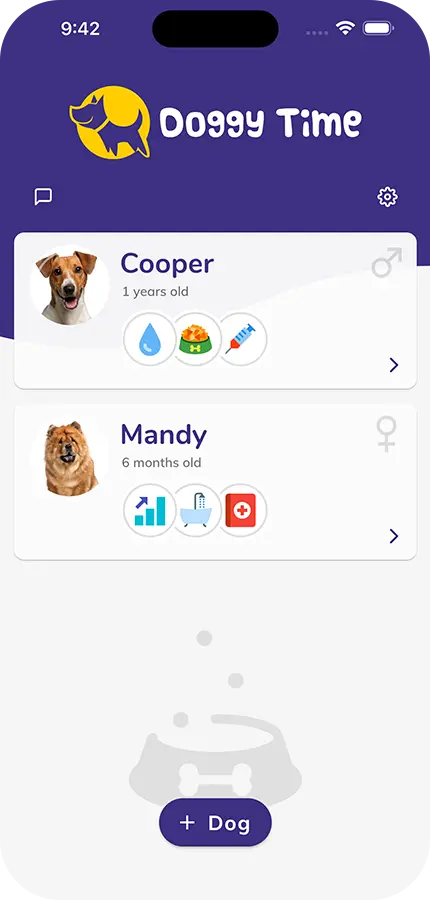
Teaching these cues takes patience, but the peace of mind is worth every repetition. To help you stay on track with your training goals, consider using the "Doggy Time" app. It helps users collaborate on logging pet activities, tracking training progress, and setting smart reminders for care schedules, ensuring your whole family is on the same page when it comes to your pet’s safety.