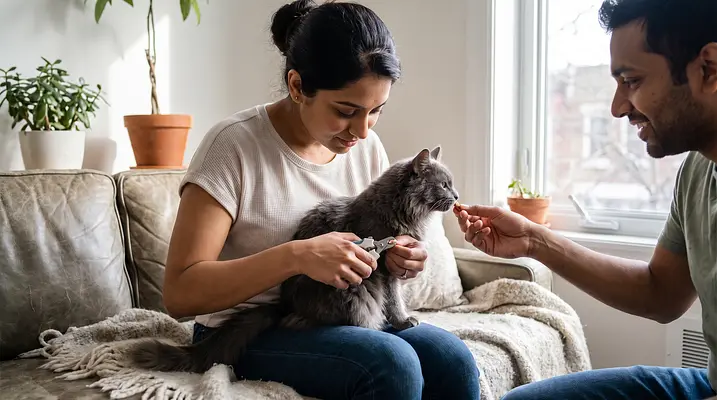
If you have ever found yourself wrapped in bleeding scratches while trying to bundle your frantic cat into a towel "burrito," you know the traditional approach to nail trimming can feel more like a wrestling match than a grooming session. While the towel wrap is a valid safety measure for medical emergencies, most routine trims can be accomplished with far less drama and zero restraint. By shifting your focus from "getting it done fast" to building trust, you can turn this necessary chore into a manageable, and sometimes even pleasant, bonding experience.
🐾 Understanding the Feline Paw
Cats are notoriously protective of their paws because they are highly sensitive tools used for hunting, climbing, and self-defense. Touching a cat's paws triggers a natural withdrawal reflex, so forcing the issue usually results in distrust and evasion. To trim nails successfully, you must first override this instinct through a patient, step-by-step desensitization process that teaches your cat that paw handling equals positive rewards.
🤝 Mastering the Art of Desensitization
Desensitizing your cat to paw handling requires patience, high-value treats, and a commitment to never pushing past your cat's comfort zone too quickly. The goal is to create a positive association with having their paws touched, so they offer them willingly rather than pulling away. This process may take days or weeks, but the investment pays off in a lifetime of stress-free grooming.
- Choose a quiet time when your cat is sleepy or relaxed, perhaps after a meal.
- Place your cat on your lap or a comfortable surface with their favorite treats ready.
- Touch your cat’s shoulder or leg briefly, rewarding immediately with a treat.
- Gradually work your way down to the paw over several sessions, stopping if your cat tenses up.
- Touch the paw gently for a second, then release and treat, repeating until the touch is ignored.
- Practice extending the claw by pressing gently on the toe pad, rewarding each successful extension.
🔍 Locating the Quick Safely
Before you make a single cut, you must understand the anatomy of the claw to avoid pain and bleeding. The "quick" is the pinkish area inside the nail that contains blood vessels and sensitive nerves; cutting into this area causes immediate pain and bleeding. Unlike dogs, a cat's quick is usually easy to see, provided the cat is calm enough to allow you to hold the paw up to the light.
- Hold the paw firmly but gently between your thumb and forefinger.
- Press down on the top of the toe and push up on the pad to extend the claw fully.
- Identify the pink triangle of tissue inside the clear part of the nail; this is the quick.
- Locate the "hook" at the tip of the nail, which is the sharp, curved part with no pink tissue.
- Plan to cut only the sharp tip, staying at least two millimeters away from the pink area.
- Keep a styptic powder or cornstarch nearby just in case you accidentally nick the quick.
🛠️ Setting Up a Low-Stress Routine
Success depends heavily on the environment you create and the tools you choose, rather than how fast you can snip. A low-stress routine involves minimizing noise, having the right equipment at hand, and respecting your cat's tolerance limits. Remember that a successful session is defined by a calm cat, not by trimming all eighteen claws at once.
- Select a pair of cat-specific nail clippers, either scissor-style or guillotine-style, that feel comfortable in your hand.
- Pick a location with good natural light where your cat already feels safe, such as a favorite chair or bed.
- Schedule the session when your cat is naturally winding down, usually in the evening.
- Warm the clippers in your hand so the metal isn't a shock to the cat's sensitive paws.
- Start with just one or two nails per session, ending on a positive note before your cat gets agitated.
- Return the cat to a favorite activity, like play or dinner, immediately after finishing.
✂️ Executing the Trim
When you are ready to cut, your technique matters just as much as your preparation. Keep your movements smooth and deliberate, and maintain a calm demeanor to reassure your cat that everything is normal. If your cat struggles, do not restrain them harder; simply pause and let them settle before trying again.
- Position the clippers perpendicular to the nail to avoid crushing or splintering the claw.
- Cut the sharp tip of the nail with a single, decisive squeeze.
- Avoid twisting or pulling the paw if the cat pulls back, and release your grip immediately.
- Check each nail for the quick before cutting, even if you have trimmed them before.
- Praise your cat in a soft, happy voice immediately after the cut.
- Stop the session the moment your cat shows signs of severe stress, such as hissing or flattening ears.
🩹 Handling Accidental Snips
Even with the best preparation, accidents happen, and cutting the quick can be a startling experience for both you and your pet. If you accidentally cut too deep, stay calm; your reaction sets the tone for how your cat perceives the incident. Making a huge fuss can reinforce the fear, so treat it as a minor hiccup and move on.
- Apply styptic powder or cornstarch to the bleeding tip with gentle pressure.
- Hold the paw still for a minute to allow the powder to clot the blood.
- Offer a high-value treat immediately to distract your cat and restore a positive association.
- End the grooming session right then to prevent further stress.
- Monitor the paw for a few hours, though minor nail bleeds rarely require veterinary attention.
📋 Quick Action Plan
You do not need to be a professional groomer to keep your cat’s nails healthy and your furniture safe. By following a gentle, consistent routine, you can maintain your cat's claws without the stress and struggle that often accompanies the task. Start small, stay patient, and remember that trust is built one nail at a time.
- Gather your clippers and treats today, but do not trim anything yet.
- Practice touching your cat's paws for three days without extending the claws.
- Extend the claws and reward for two days before attempting a cut.
- Trim just the very tip of two nails on the first attempt.
- Slowly increase the number of nails per session as your cat’s tolerance grows.
- Celebrate every successful snip with praise or a treat.
Keeping track of your progress can be incredibly helpful, especially when you are working on a long-term desensitization plan. Consider using the "Doggy Time" app to log your training sessions, set reminders for nail trims, and monitor your cat's tolerance levels over time. This collaborative tool helps you stay consistent, ensuring your feline friend stays comfortable and healthy.
Disclaimer: This article is for informational purposes only and does not constitute professional veterinary advice. If your cat’s nails are severely overgrown, curling into the pad, or if you are unsure about the anatomy of the claw, please consult a veterinarian or professional groomer.